
EMOM vs. AMRAP – two workout formats that look pretty similar at first glance. Both work within a fixed time frame, and both can make you sweat properly.
But while the clock tells you when to go in an EMOM, you set your own pace in an AMRAP.
So which format is better for strength, endurance or conditioning? We’ll tell you!
Quick tip: Get your SmartWOD Timer ready!
EMOM vs. AMRAP: The Differences at a Glance

EMOM and AMRAP are among the most popular workout formats in functional fitness. The biggest difference is how you divide your time.
| Comparison | EMOM | AMRAP |
|---|---|---|
| Meaning | Every Minute on the Minute | As Many Rounds/Reps as Possible |
| How it works | New task at the start of every minute | As many rounds or reps as possible within the time |
| Rest | Whatever time is left after your reps | Self-managed |
| Pace | Structured by fixed intervals | Self-regulated |
| Typical focus | Consistency, technique, controlled load | Pacing, endurance, work capacity |
Important: An EMOM isn’t automatically easier than an AMRAP. How intense your workout gets depends on the exercises, reps, weights and your training intensity.
What Is an EMOM and When Is It Worth It?
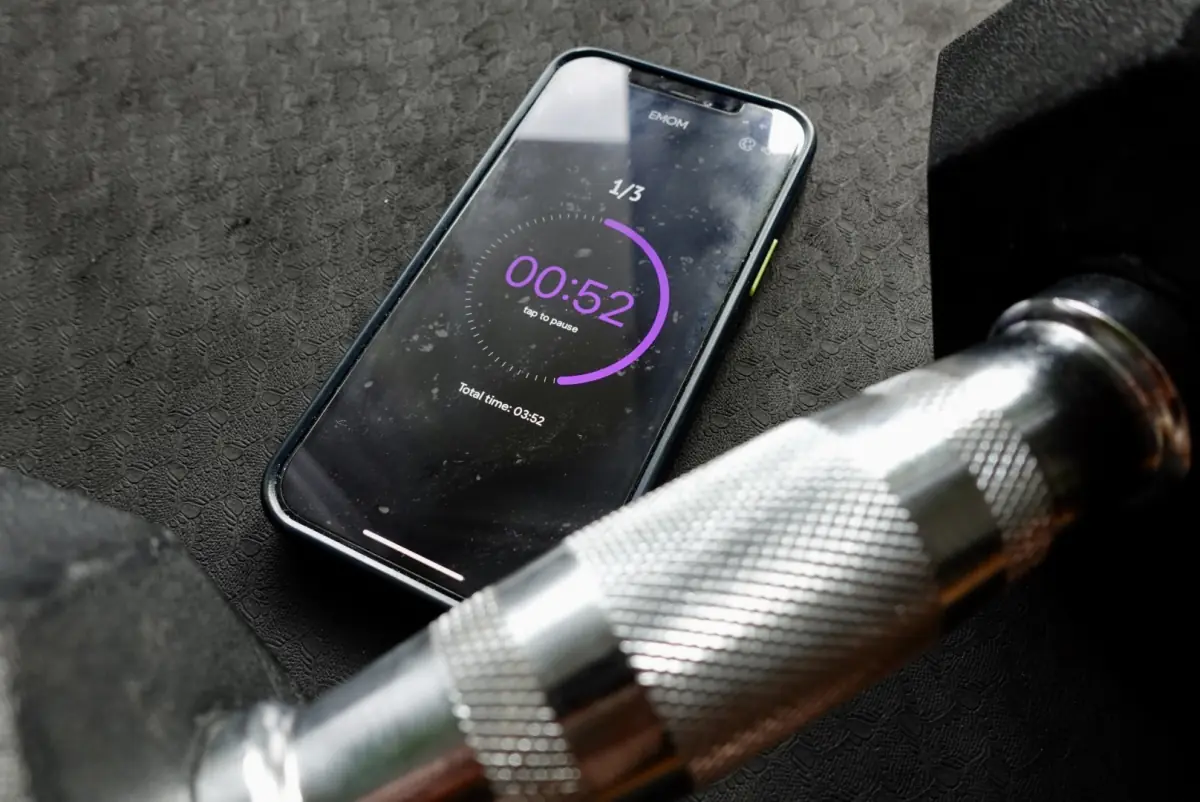
EMOM stands for Every Minute on the Minute. That means you start a set exercise at the beginning of every minute. As soon as you’ve finished all your reps, the time left over is your rest.
An example: you have to do ten kettlebell swings every minute. If that takes you 25 seconds, you get 35 seconds of recovery. After exactly one minute, the next round starts.
That makes EMOMs especially useful when you want to manage your load deliberately.
The Benefits of EMOM Training
- Predictable load: You know exactly when the next round starts and how much time you have.
- Controlled reps: With enough recovery, you can focus more on clean technique.
- Measurable progress: You can gradually increase the reps, the weight or the number of rounds, for example.
- Versatile training stimuli: Depending on how you set it up, an EMOM works for strength training, skill work or conditioning.
There is a catch, though: if you plan too many reps, there’s hardly any time left to recover. A controlled EMOM then quickly turns into a race against the clock.
Sample Workout: 12-Minute EMOM
EMOM 12 minutes:
- Minute 1: 12 Air Squats
- Minute 2: 10 Push-ups
- Minute 3: 12 Kettlebell Swings
You repeat the three minutes four times in total.
Try to do the reps cleanly and at an even pace. If needed, adjust the numbers so that you still have some recovery time after each task.
Tip: With the SmartWOD Timer, you can set up your EMOM and focus entirely on your workout. The timer signals when the next minute starts.
What Is an AMRAP and When Does It Make Sense?

AMRAP means As Many Rounds/Reps as Possible. Your goal is to complete as many rounds or reps as possible within a set time window.
Unlike an EMOM, there are no prescribed rest periods. You decide for yourself how fast you work and when you recover.
That’s exactly what makes AMRAPs so interesting: it’s not just about being as fast as possible, but also about managing your energy well.
The Benefits of AMRAP Training
- Effective conditioning: The continuous load challenges your endurance and work capacity.
- Better pacing: You learn to find a pace you can hold for the whole workout.
- Easy progress tracking: Completed rounds and reps can be compared under identical workout conditions.
- Flexible intensity: You can keep an AMRAP deliberately moderate or push yourself to your limit.
The biggest challenge? Not starting too fast. If you go all-out in the first few minutes, you’ll often lose far more time later through unplanned breaks.
Sample Workout: 12-Minute AMRAP
AMRAP 12 minutes:
- 12 Air Squats
- 10 Push-ups
- 12 Kettlebell Swings
You complete as many rounds as possible within the twelve minutes.
The exercises are the same as in the EMOM. The difference: you don’t have to wait for the next minute to start – you can move straight on to the next exercise.
That changes the load. You decide when you need a break and how long it lasts.
Tip: Start the AMRAP timer in the SmartWOD app and try to hold a pace that’s as consistent as possible for the entire time.
EMOM or AMRAP: Which Is Better for Your Training Goal?

The answer depends on what you want to achieve with your workout. Both formats can be set up in different ways and aren’t limited to one specific training stimulus.
For Strength and Technique: EMOM
If you want to work on your technique or train demanding movements with enough recovery, an EMOM is often the better choice.
For example, you can do a few heavy deadlifts, controlled pull-ups or a set number of handstand push-ups every minute.
The advantage: the fixed structure helps you plan enough recovery between sets – provided you’ve chosen a sensible number of reps.
For maximal strength development, though, you often need longer rest periods than a classic one-minute EMOM offers. Read more in our article on rest between sets.
For Endurance and Conditioning: Both
Both EMOMs and AMRAPs can improve your endurance.
- An EMOM is especially suited to repeated efforts with fixed recovery phases. You could combine intense intervals on the Assault Bike with easier minutes, for example.
- In an AMRAP, you manage the load yourself. That’s especially useful if you want to learn to hold a consistent pace over a longer period.
What matters isn’t the format alone, but how you design your workout.
For Muscle Growth: It’s All About the Load
Can you build muscle with EMOMs and AMRAPs? Basically, yes.
But for hypertrophy, what matters most is a sufficient training stimulus, training volume and sensible progression.
An EMOM can help you complete repeated strength sets in a structured way. An AMRAP can also create a muscle-building stimulus, but fatigue and time pressure can affect your form and the weight you use.
So if building muscle is your main goal, you shouldn’t put the workout format above the quality of your strength sets.
For Pacing and Competition Prep: AMRAP
In functional fitness especially, good pacing is crucial.
An AMRAP challenges you to regulate your own pace for the whole workout. You have to judge when you can push and when a short break makes more sense.
EMOMs can help on top of that by teaching you to perform specific movements more efficiently under repeated load.
EMOM vs. AMRAP: Why Not Both?
You don’t have to choose between the two formats. On the contrary: EMOMs and AMRAPs complement each other perfectly.
For example, use an EMOM to work on your technique, consistency or repeated strength output. On another training day, an AMRAP can challenge your endurance and pacing.
With the SmartWOD Timer, you have the right timer for both formats at hand. And if you run out of workout ideas, the SmartWOD Workout Generator has fresh training inspiration for you!